Author: Glenn S. Robertson
Published: 2026
Mood: If you spend every night doomscrolling and hate the way the world is headed but also want to read a Western that tackles exactly the way the world is headed so you can prepare.
“The Red Death came not as a thief in the night but as a herald in daylight, announced by sirens, sickness, and silence. The hospitals closed. The radios died. The dead stacked in the basements like cordwood.”
There is nothing more unsettling to me than post-apocalyptic stories.
I can contentedly watch the most horrifically violent action movies with blood and guts flying everywhere, and read horror novels about cannibals, vampires, demons, and psychological terror. But when you give me a horror that’s brought on by humanity, by something we did or neglected to do, that freaks me TF out – because it’s POSSIBLE.
And yet I keep consuming them. It’s like the hyenas saying ‘Mufasa’ over and over again. I want that shudder.
Seeker is a post-apocalyptic Western that came to me through my Westerns group. It’s exactly what I’m genuinely afraid of – a virus wipes out most of the world and results in an eerily realistic, violent and desolate future for North America. But the concept is so fascinating, and the characters are so fresh, that I embraced the shudder.
Here’s what you need to know, including insights from author Glenn S. Robertson.
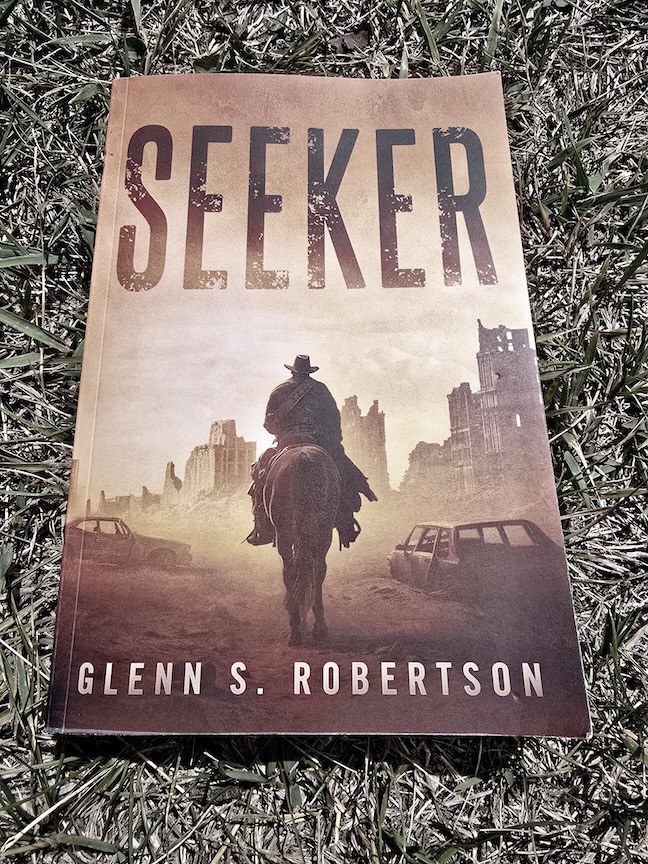
Seeker is a Western set in the 2130s. Most of humanity has been destroyed by a virus referred to as the Red Death. Or by being bombed in attempts to contain the Red Death. Either way, there’s almost nothing left of civilization. Tiny, poorly armed local governments and law enforcement are in a constant state of fending off attacks, giving the story a classic Western flavour – scarce necessities, horseback travel, and clashes over power and land.
Author Robertson peppers the chapters with excerpts from newspapers dated from 2025 through the next couple of years, and also pages from diaries found over the next century, transcribed graffitti, and other tidbits of the people who survived and came afterwards.
These scraps of the past are secretly collected by Ghost, a Seeker, on his missions. Seekers are hired to find precious objects for people with something worthwhile to trade. These missions require dangerous trips outside the walls of communities like Casper, a small city in the Rocky Mountain Free Zone that’s enclosed in walls and towers made from old vehicles and scrap metal.
There are several strains of violent outlaws in this new world, most importantly the Disavowed (a mercenary army that started out as US paramilitary during the plague and now fights for pay), and the Jacobites (Mormons who serve the Kingdom of Jacob under King John, a fat bastard who’s determined to take it all).
And then, satisfyingly, there’s also the threat of crossing the Native Americans. The continent’s environment has returned to a wild, pre-colonization state, and the tribes that are left have risen to become a formidable force against anyone who strays into their vast territory.
A girl named Neva is taken from Casper by raiders. Ghost sets out to find her, with a seemingly ragtag group of men. But as the plot unfolds, the characters’ pasts and ties are revealed. A war is brewing, and everyone is a key player – whether they like it or not.

My favourite things about Seeker are the excerpts from the past. OBVIOUSLY. Yes, I’m a former journalist and former library worker, which you would know if you care about me at all, which you don’t because you have a life and I’m just a human behind a screen. But I’m also a glutton for punishment. Reading the military emails, articles, and diary entries totally sent me because they sound just like what’s going on today.
The world that author Robertson has created is not immediately fantastical, like Cowboys vs. Aliens. It’s exactly what I think would happen if we were hit with this kind of virus. Panic, bombing, xenophobia. Hell, all of that’s already here.
You get a heady mix of emotional diary entries – like one from 2027 that laments the total loss of music and the oppressive silence – recipes scribbled down in case someone can carry them on, confidential military emails that express fear and doubt about orders, and other deeply human scraps of meaning. They slowly weave the backstory of what happened, and it gets increasingly hard to read.
“No matter what the future holds, I do feel that the idea of localized communities having to rely on deep self-sufficiency is increasingly relevant, and likely something we could all probably benefit from cultivating,” said Robertson.
I also LOVE Seeker has no forced love stories with stoic guys and ‘fiery’ women. Just a lot of healthy, close friendships and bonds.
And then, of course, there’s the efficient, precise framework of both the past events and current strategies of each armed force. These are so logical and well-played because of Robertson’s own background.
“I served in the Navy for six years active duty, and another year and a half in the reserves. That experience definitely informed my understanding of structure, discipline, and operating in high-stress environments, which influenced the kind of self-reliance Ghost needs in the post-collapse West.
“I’ve also worked as a civilian for the Air Force for nearly ten years, which has added another layer of background to Seeker. There are several references to the ICBM mission in the first book, which I feel is inextricably linked to southeast Wyoming.”
Robertson also has a BA in History, worked as a military journalist, was recognized as the Department of Defense Civilian Writer of the Year for the 2025,
There are lots of great characters in Seeker. Possibly too many. I’m a slow reader, so sometimes I would forget a name and have to flip back a few chapters to remind myself who someone was. But they’re all relevant, and they all have a purpose.
I enjoy Ghost as an anti-hero because he’s blunt, focused on getting things done, has his own strict set of life rules, and has an appreciation for writing. He’s a highly skilled fighter and combat strategist. I’m a blunt, lawful evil digital strategist who sometimes remembers to lift weights. We’re so much alike.
But in all seriousness, I appreciate that Ghost isn’t a jacked-up dude who never makes mistakes and is good at everything and smoulders at women. He’s flawed and human and also self-aware, and it makes him accessible to the reader.
Neva is a healthy young female protagonist, and has the most badass (spoiler: paranormal) power that sometimes makes her stronger than all of the battling men. But she’s also a team player, and acts her age.
A good story needs a strong villain, and King John is an evil, righteous blowhard who has the power and resources to do serious damage. But while Seeker builds towards the big boss fight, you get plenty of skirmishes with lesser evil-doers who are every bit as armed AND disgusting.
Carl is a strong, frequently entertaining balance to Ghost. Mashalmon becomes an increasingly interesting figure who, for some reason, I can’t stop picturing as Christopher Lee. I don’t really get people with an excess of moral fibre, so I didn’t relate to Leonidas and Hannibal – but I seriously adored their friendship and the way it was written.
My note about Mashalmon is key, because the entire time I was reading Seeker, I was picturing how it would work in a movie. And it should be a movie – I would 100% watch it and was casting it the entire time I was reading. There were plot points where I felt like the story was limited to describing battle to a reader, but these are more easily communicated through visual media. I got it, but it felt like it went so far beyond words.
With that said, I have only ONE tiny critique for Seeker, and it comes from my place as a lifelong writer and editor who experiences writing through a highly personal, and recently discovered to be autistic, lens. Most people probably won’t even notice it, but you know I’m all about transparency.
Seeker frequently uses descriptive speech tags in place of “he said” or “she said.” Most reviewers actually love this, and don’t get me wrong, I was HERE for the descriptive language in every other element of the writing. But these tags sometimes took me out of the flow because I got hung up on words that felt too aggressive, dramatic, or otherwise not in line with the conversation or how I perceived the character in that moment.
That’s it. And for anyone who knows me, that’s a massive testament to the quality of Seeker, because I can be a real asshole about the technical elements of writing (flashback to Unicorn Western).
I can’t explicitly call this post-apocalyptic Western a ‘fun’ read because it was emotionally taxing for me as a person who is afraid of everything happening in the world right now, and that’s not fun. But it doesn’t have to be fun. It is CAPTIVATING. It built up to become a real page-turner. And I got to read a book from a fellow writer who loves Westerns the way I do, and learned about his take on the genre.
“My connection to Westerns is deeply rooted in my upbringing and Wyoming itself,” said Robertson. “I’ve always appreciated the genre’s focus on (re)building civilization, personal codes of conduct, and both the harshness and the beauty of the frontier landscape. It’s a genre that asks big questions about what it means to be civilized.
“I also grew up on movies like Tombstone and Unforgiven, and then later, such movies and stories as True Grit and Open Range, among many others. The ideas of Western and post-apocalyptic fiction are very much intertwined. One of Seeker‘s overarching premises is that a world, post-apocalypse, would look a lot more like a western than the crumbling cities you see in a lot of post-apocalyptic fiction, particularly once you leave the city setting for places like Wyoming (or western Canada, for that matter).”