Author: Stephen Graham Jones
Published: 2025
Mood: If you’re a creature of habit who always eats the same food and wears the same clothes and follows the same routes and you’re ready to be shaken to your core but from the safety of your armchair.
The Buffalo Hunter Hunter is so good that it made me desperate to get back to my own creative writing. It awakened my thirst for telling a story that hits people hard, and stays with them long after they’re done reading.
When I ordered this book it was just an impulse based on some algorithmic recommendation. I didn’t even realize that I already had another book by Stephen Graham Jones in the leaning tower on my nightstand, waiting for my slow ass to get to it. THIS one sounded really good, and so when it arrived I placed it at the top of the pile.
Apologies to every other book in that stack… and to the many, many others that are waiting on various shelves and haven’t even yet made the pile.
Back on topic: HOLY SHIT. This is not a book to be missed. If you appreciate great storytelling, richly detailed period pieces, and love a slow burn, you’ll be immensely satisfied right through to the final page.
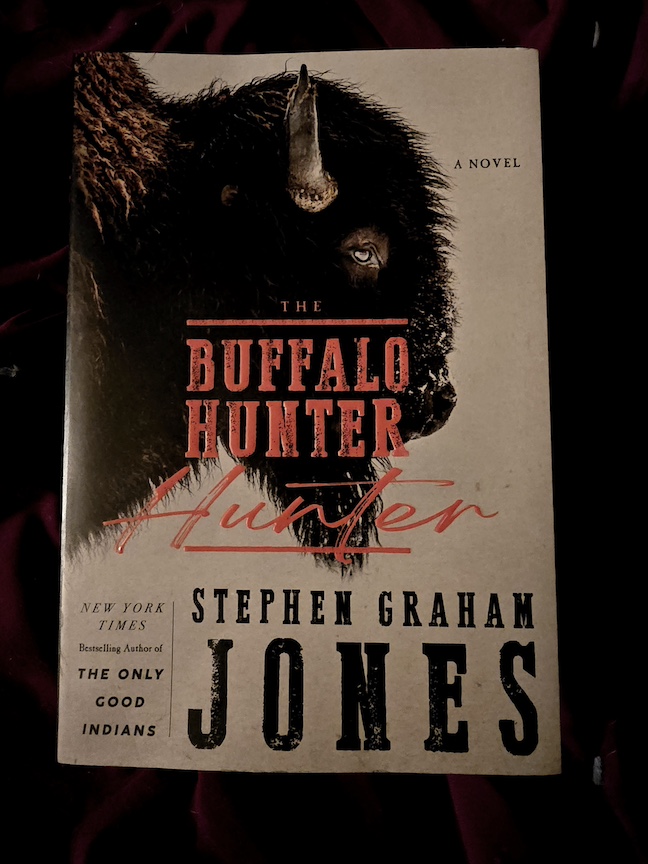
The Buffalo Hunter Hunter is diary fiction, mostly told by Lutheran pastor Arthur Beaucarne in 1912. His journal has been found in 2012, in the walls of a building being demolished, and landed in the hands of Etsy, a Communication and Journalism professor who keeps her own journal.
Arthur Beaucarne is Etsy’s great-great-great grandfather, and he has a massive burden to get off his chest.
Arthur’s logbook relates the fascinating confessions of a Blackfeet man who starts appearing at his church. Good Stab is a Pikuni (one of three Blackfeet nations). He was born “the year the stars fell,” which is some time in the 1833-34 Leonid meteor shower, yet he appears younger than Arthur.
Over the first few sessions, Arthur looks down on Good Stab, and Indians in general, and treats his supernatural stories as impossible ‘savage’ imaginations. But Good Stab shows every possible sign (to modern readers) of being a vampire. And while Arthur wants to ignore the obvious, the Pikuni’s dark tale illuminates terrible events in American history.
Meanwhile, skinned bodies are piling up around town. Arthur is increasingly uncomfortable, and even tries to get local law involved. But what has started can’t be stopped until it reaches its grizzly conclusion – one that involves the reconciliation of Arthur and every last one of his kin.

My favourite kind of historical fiction is the type that educates you without feeling like a lecture, and puts a plausible, creative spin on real events. The Buffalo Hunter Hunter flawlessly executes on that assignment.
Its central theme is the Marias Massacre, in which approximately 200 Blackfeet people were killed by the US Army, while in their lodges, in the middle of winter, despite presenting the chief’s safe conduct documentation. You learn about this in a roundabout way through the backstory of Good Stab, and later, Arthur’s own past.
While reading the first parts of the book I was digging the language and the immersive frontier details, but wasn’t really getting ‘horror’ fiction from it. At the halfway point, all I had was:
- Skinned bodies, described in some detail but giving more ‘forensic mystery’
- Brief, undetailed mentions of colonization (which IS horror, but only mentioned to that point at a surface level)
- One short skirmish, bloody but also brief
I assumed that the massacre was the horror, and was ready to accept it and still enjoy the book as strong fiction. But then it suddenly went darker than anything I could have seen coming.
The Buffalo Hunter Hunter leads you gently along by the nose, keeping you uncomfortable with Arthur’s stereotypical views of people and events but never scared. Then the pieces all come together, and you get this gloriously brutal scene in which Arthur is being physically tormented, and I won’t give anything away because you just really need to read it but trust that when the story bares its teeth they are REAL.
When I got to that part I was like, “how TF are there still 200 pages to go?!” It felt like the big reveal had happened, and I couldn’t imagine what else there could be. Knowing that there was more and that I couldn’t begin to fathom its depths made it deliciously suspenseful.
The second climax and everything else in the last third of the book are all such a great payoff.
What I love most about this book is that it’s storytelling about storytelling.
The author is a talented writer. Arthur is a meticulous diarist who wants to document Old West ‘novelties’ that will soon be lost, specifically all things Native. And Good Stab is gifted at his tribe’s tradition of oral storytelling, or įkaitapiitsinikssiistsi.
And then you get Etsy, who uses fresh, modern verbiage that feels like someone legitimately freaking out while talking to their cat. She’s got big Ripley (Alien) vibes, bravely going off into grave danger with a cat carrier. Her story perfectly bookends the whole thing.
I forget most books as soon as I’ve finished them, because I work long days, I do mentally taxing work, and I barely read three pages a night before I fall asleep. My brain just can’t hold anything else. But The Buffalo Hunter Hunter is still calling to me, reminding me of its scenery, its characters, its message.
And that ending. Oh, that ending.