Author: Edward Abbey
Published: 1956
Mood: If you feel totally at odds with the world and want to read a Western about a cowboy who is probably way more at odds than you are yet keeps fighting the good fight.
I have NO idea how or why I ended up with a copy of The Brave Cowboy. Seriously.
When I selected it from the leaning tower of to-read books on my nightstand, I assumed someone from this site’s awesome community had recommended it to me. But there’s no record of it being mentioned anywhere in the group. It’s also not in any of my online order histories, nor does it have price sticker residue from my local bookstore.
What I do know is that when I started reading The Brave Cowboy, I immediately thought of the dramatic opening scene from Kirk Douglas’s masterpiece Lonely Are the Brave, and then Google informed me that this is the book that the movie was based on. Yet I’m still 99.9% sure that I had no clue about the connection when I bought it.
Anyway, enough of my inane monologuing. You came here to read an actual book review. And this is such an incredibly well-written, unique, and gripping story that you’ll immediately see why Kirk Douglas fell in love with it, bought the rights, and forever called it his favourite movie he ever made.
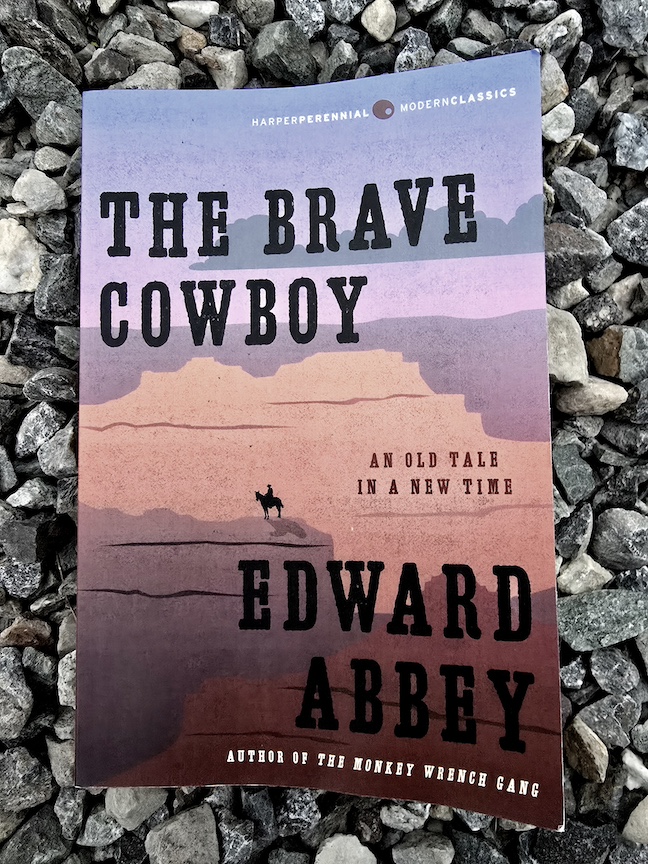
The Brave Cowboy is the story of Jack Burns, a cowboy who picks up work here and there, lives off the land, and roams the countryside. But Jack doesn’t live in the 1800s. He and his horse, Whisky, are sitting on a New Mexico mountainside in the mid-1950s.
Jack makes a rare trip into the city limits to visit Jerry Bondi, the wife of his best friend, Paul. Paul is in jail for refusing to register for the Korean War draft, leaving Jerry facing two years on her own with their son. Jack is a great BFF and all-around good person who kinda sorta has feelings for Jerry, so his grand plan is to break Paul out of jail.
All it takes is an evening of drinking and brawling at a rough bar for Jack to get himself locked up. But once inside, he finds Paul unwilling to budge. Meanwhile, the cruel, violent prison guard Gutierrez has discovered details from Jack’s past that could keep the wandering cowboy locked in a cage for a long, long time.
Will Paul go along with Jack’s scheme? Actually, you find out pretty quickly – almost half of the book takes place on a manhunt. Grab your tissues ahead of the ending.

It’s been hard to put into words what I love so much about The Brave Cowboy, which is why this review has taken me WAY longer to write than most. I just really want to do it justice.
The first thing that stands out about this book is how different it is from other Western novels of the ‘50s.
- It doesn’t take place in the Old West
- The cowboy protagonist is presented as being ‘weird’
- It touches on draft dodging, but of the Korean War, not Vietnam
- Jack and Paul are anarchists, but good guys, not antiheroes
Similarly to The Ox-Bow Incident and High Noon, The Brave Cowboy pokes at society’s tightly-held beliefs and morals. It asks WHY. Why does a man have to have an address to matter? Why can a man be jailed for his own beliefs, while others’ beliefs are the law?
And then author Abbey’s writing is just so immersive. Picture Louis L’Amour, but with even more attention to subtle detail, and significantly better at character-driven narrative. If you’re reading a scene, literally no stone is unturned. Everything is captured in meticulous detail, so that even if you’ve never seen the specific mountains and highways and trials, you’re right there with the characters.
I admit that I felt like Paul’s flip-flopping and argument in the jail went on a bit too long-winded. But that’s because I was fully on Jack’s side and couldn’t relate to Paul at all. Sure, the guy was being practical about his future. He was also going against his own code by holding his philosophical ideals over his wife. And Jack just meant so well, it was impossible to see any wrong in his character or his perspective.
I do wish that I had read the book first, because the movie is a little more exciting – mostly because Kirk Douglas was so damn charismatic, but also because there wasn’t quite so much time spent on Paul’s philosophizing, which other people may enjoy but I got tired of reading.
The scriptwriter, formerly blacklisted writer Dalton Trumbo (Spartacus, Exodus, Roman Holiday), also chose to make Paul’s criminal offense helping illegal immigrants instead of draft dodging, and made Jack a decorated veteran. I think those choices were a smart move to make the characters even more sympathetic for movie audiences, especially Jack.
Personally, I was already on board with everything Jack stood for, to the point where I sometimes find myself wallowing in moments self-loathing for owning fences on land that wasn’t meant to be fenced in. But I get how Jack’s refusal to enlist could be off-putting, since both the book and the movie came out before the mid-’60s wave of anti-establishment, counterculture sentiment.
English writer and director Alex Cox, who made crazy anarchist movies like Repo Man and Sid and Nancy said, “there is no greater western, and certainly no more tragic one.”
True, that was about the movie. But the book is a must-read for Western fans. Especially those who love stories about guys who love their horses.