Starring: Joel McCrea; Maureen O’Hara, Linda Darnell, Anthony Quinn, Edgar Buchanan
Director: William A. Wellman
Released: 1944
Mood: If you’re sick and tired of the miserable news of the world and need to escape into a story that makes you believe that if you shoot for the stars you’ll actually become one.
“I think it becomes unattractive for an older fellow trying to look young, falling in love with attractive girls… I always felt so much more comfortable in the Western. The minute I got a horse and a hat and a pair of boots on, I felt easier. I didn’t feel like I was an actor anymore. I felt like I was the guy out there doing it.”
Joel McCRea
I don’t know what it says about me that apparently what my soul needed more than anything right now was a romantic – and romanticized – Western. But here we are. I kind of love Buffalo Bill.
Buffalo Bill (the man) was an icon and a legend – and he had absolutely no problem inventing many of those international ‘legends’ himself.
- Fun Fact #1: Buffalo Bill Cody would have been a dual citizen in today’s world, because his father was Canadian and Cody was born in Ontario.
But through Cody’s actual documented actions he really did earn his place in global history, and was undeniably worthy of being the topic of countless movies, books, dime novels, and the namesake for one of cinema’s most memorable serial killers.
Like any ‘40s Western, Buffalo Bill (the movie) has some uncomfortable elements, namely the non-Indigenous actors playing Natives, a lot of saying “How” (the people portrayed weren’t among the few tribes that said “háu” as a masculine greeting), and one SUPER cringe scene where a ‘strong Cheyenne’ woman puts on a gown because she wants to know if she can be pretty in the white woman way and then flies into a jealous rage over Buffalo Bill.
But overall, it’s a really well-made movie with strong acting and heaps of exciting action.
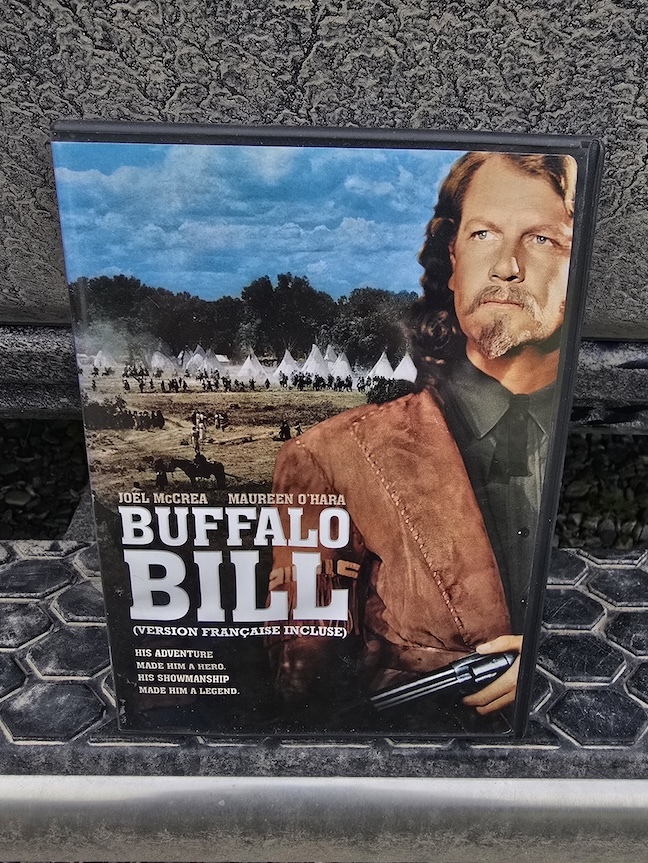
Buffalo Bill tells a somewhat fictionalized, but also partly historically accurate, recap of “Buffalo” Bill Cody’s life. To spot the differences I highly recommend reading up on Cody’s tumultuous married life, his traveling show, and the Battle of Warbonnet Creek.
It begins with a dramatic stagecoach hijacking. The beautiful Louisa Frederici (Maureen O’Hara) and her Senator father (Moroni Olsen) are rescued by handsome army scout Buffalo Bill (Joel McCrea). Everyone in their group assumes that it was hostile Indians, but Cody is quick to point out that the weapons and style of the attack don’t align with the ‘good’ Indians. He further states that the country’s Indigenous people are right to be upset with the white people.
Bill and Louisa marry, and although she’s not the biggest fan of the rough frontier life, all seems well. Meanwhile, we learn of Bill’s friendship with a Cheyenne man named Yellow Hand (Anthony Quinn). Yellow Hand owes him a debt, which is soon cashed in to aid the Frederici family. Yellow Hand makes it clear that if they meet again in conflict, he will treat him as an adversary.
Yellow Hand becomes Chief. The buffalo population is decimated. Treaties are broken, tensions rise, and the white people get greedy for more Native land. Bill struggles with conflicting loyalties to the US Military, his wife, and the Indigenous people that he’s come to know and respect.
And through it all are brief encounters with journalist Ned Buntline (Thomas Mitchell), who’s determined to make Bill into the most sensational star of his time.

If I was a teenager when this movie came out – or let’s be honest, any friggin’ age – I would have had posters of Joel McCrea as Buffalo Bill on my bedroom walls.
He’s tall. He’s barrel-chested. He’s got a fine-ass moustache. And because of his personal values, McCrea radiates this humble warmth, level-headedness, and compassion that work perfectly for this version of the Cody character.
- Fun Fact #2: Joel McCrea turned down military hero roles because he was too old to be enlisted in WWII, so he felt it was inappropriate to do those characters – and he also turned down numerous roles that he just didn’t think he was good enough to play.
- Fun Fact #3: Buffalo Bill Cody was also mostly a good guy, working from age 11 right up to his death and supporting Indigenous civil rights, employing Indigenous people as actors in his shows, openly blaming the US for causing battles by breaking promises and treaties, vocally supporting women’s suffrage, and becoming a conservationist who advocated for declaring hunting seasons.
If I had to pick one word to describe Anthony Quinn, it would be gravitas. When Quinn speaks on the screen in any movie, including this one, you listen. You can tell that he’s fully immersed in the character.
Although Quinn wasn’t Native, the commanding presence and dignity he brings to the role of Chief Yellow Hand (a real person whose name was Heova’ehe or Yellow Hair, usually incorrectly translated) feels respectful – unlike Linda Darnell as the emotional Dawn Starlight.
- Fun Fact #4: Linda Darnell did have a Cherokee great-grandparent, but she never engaged with that part of her heritage – and a Fox studio head wanted her to be seen as exotic and “vaguely Latina” so he scrubbed any references to her lineage from press releases and her studio biography.
- Fun Fact #5: Anthony Quinn was born in Mexico during the Mexican Revolution, refused to hide his heritage, was an advocate for Latino representation, and was the first Mexican-born actor to win an Oscar.
To be fair, Darnell was a 19-year-old female who didn’t dare push back against Hollywood, and the annoying uselessness of her character can be blamed on the script. The movie DID bring in local Navajo people to play the majority of the other Natives, unlike other Westerns of the same era that mostly used white extras in brownface or people from other races.
Buffalo Bill’s production team seems to have either genuinely tried to be more authentic, or to have inadvertently been ahead of its time when it came to casting.
Maureen O’Hara was still relatively early in her career when she made Buffalo Bill, but she’s as stunning and charismatic as ever. Her delivery is always this curious blend of theatricality and subtlety, so that even when she’s saying somewhat melodramatic lines, it always comes across as genuine.
Buffalo Bill has shockingly great cinematography. The big battle scene at Warbonnet Creek has what looks like hundreds of extras galloping straight at the camera, many of whom are BAREBACK. The camerawork totally holds up.
The action is plentiful. The minor characters – other than Dawn Starlight – are entertaining. You get everything you want in a classic Western, and that’s why we’re here.