Starring: Franco Nero, Eduardo Fajardo, José Bódalo, Loredana Nusciak
Director: Sergio Corbucci
Released: 1966
Mood: If someone has really pissed you off and you need a movie with a massive body count but not too much gore because you’re also eating your feelings.
Do you ever get a feeling, almost like pre-disappointment, when you’re about to watch a movie that has SO MUCH HYPE and everyone swears it’s the best but you doubt it could be that good?
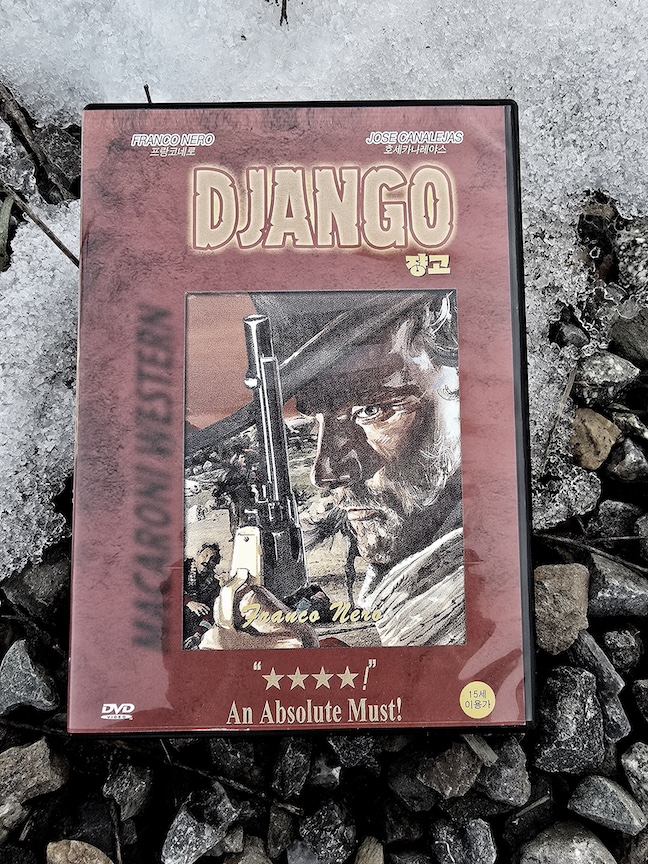
That’s how I felt when I put on Django, which is kind of ridiculous since I was the one who spent $35 on the DVD. Nobody twisted my arm, I could have just as easily not bought it.
But it’s frequently hailed as one of the best Spaghetti Westerns of all time, with 7.2/10 on IMDb, 94% on Rotten Tomatoes, 75% on Metacritic. I’m a person who reviews Westerns, so I felt like I had to watch it. I just assumed I wouldn’t like it.
Well, the great spaghetti spirit was guiding me – and my credit card – that fateful day. Hot damn, is Django a great film. It has EVERYTHING that I love about Westerns, and more. Believe the hype, my friends. You absolutely have to see Django.
The opening credits roll out over a scene that can only be called iconic. I will accept no other description, and I loathe how overused that term is these days – so you can trust me when I gush over this nearly three-minute scene where Django (Franco Nero) drags a coffin across a muddy desert, a saddle slung over his back and his Union uniform splattered with sludge.
- Fun Fact #1: Apparently this scene was shot as a prank by director Corbucci. He instructed Franco Nero to walk up a hill dragging the coffin, and when Nero got to the top, the crew had packed up and left.
Django finds a scantily dressed woman (Loredana Nusciak as María) being whipped by a group of Mexican bandits. But then the bandits are killed by Major Jackson (Eduardo Fajardo) and his posse, who want to burn María on a cross. Django kills some of the men, others run off. He tells María that she’ll have protection with him.
They arrive in a town with almost no people, just a bartender (Ángel Álvarez) and five prostitutes. The town is a neutral zone between Jackson’s ‘Klansmen’ and the Mexican revolutionaries led by General Hugo Rodríguez (José Bódalo).
- Not-So-Fun-Fact #2: Django‘s credits, and current online credits including Wikipedia, refer to these characters as Klansmen. Director Corbucci supposedly studied footage of the KKK while writing the script. But the characters wear red hoods and shirts, which were the attire of the racist paramilitary Red Shirts that terrorized Black people in the South from the 1860s to the early 1900s.
Jackson arrives expecting to kill Django, but once again Django handily dispatches his men. Then Rodríguez’s men roll into town and, PLOT TWIST, Django is friends with Rodríguez and convinces him to steal gold from Jackson.
The rest of the movie is nonstop backstabbing, ear-severing, Trojan horse-style invading, machine-gun-killing… and some quicksand thrown in for good measure.
- Fun Fact #3: The name ‘Django’ is a nod to Roma jazz guitarist Django Reinhardt, who had paralyzed fingers, foreshadowing events later in the movie.

I expected Django’s character to be gruff or even mean, because that’s how a lot of the men are in Spaghetti Westerns (hello, Clint!). Django doesn’t talk much, but he’s a much more accessible anti-hero and that resonated with me.
He’s still totally ruthless and self-serving, but there’s a subtle charm to Franco Nero’s performance that the ‘Man in Black’ trilogy didn’t get until Lee Van Cleef joined the cast for A Few Dollars More. Terence Hill’s character in They Call Me Trinity is clearly a sweeter, funnier version of Django.
- Fun Fact #4: A Fistful of Dollars and Django both borrowed characters and plot from Akira Kurosawa’s 1961 samurai film Yojimbo. Because Dollars was technically a remake and had failed to secure the rights, production company Toh successfully sued Sergio Leone for 15% of his movie’s revenue and distribution rights in Asia. Corbucci’s looser adaptation was left alone.
Everyone else in Django is quite good. Eduardo Fajardo smoothly delivers a distinguished yet despicable bad guy in Major Jackson. José Bódalo plays General Hugo Rodríguez as the kind of man who will laugh with you over drinks, and laugh just as hard as he teaches you a violent lesson for betraying his trust. And Loredana Nusciak gives you a bit more than the usual smoky-eyed femme fatale.
Django was considered to be the most violent movie of its time. It wasn’t even allowed to be shown in the UK until 1993! And although it doesn’t compare to the splatter-gore movies we have now, it’s still rich with brutality.
- Fun Fact #5: Django reputedly has a body count of 180, including an impressive 79 from Django himself.
Where it differs from modern gore is that most of the violence is implied. You see people shooting and other people reacting, a knife being put next to a man’s face and then him clutching his ear, or men making pounding motions with guns and then Django’s mutilated hands.
But that doesn’t make it any less enjoyable. Django fills almost all of its 90 minutes with fast, glorious action. Of particular note is the custom-made, belt-fed machine gun inspired by the 1895 Maxim gun. I get an extra kick out of Westerns with Gatling guns, like The War Wagon and The Magnificent Seven (2016), so this addition made me giggle with delight.
Django developed a massive cult following, inspiring media across genres from the Star Wars movies to the Samurai Jack cartoon and the Red Dead Redemption video games.
Its unique style and immense popularity resulted in one sequel involving Nero and Corbucci, and dozens of ripoff ‘sequels’ and movies using the character’s name, but also some higher-quality nods like Quentin Tarantino’s Django Unchained.
- Final Fun Fact: Franco Nero has a cameo in Django Unchained, and also appears on two episodes of the 2023 TV series Django.